Quality Reports - Chicken | Licious
Licious
Licious Logo
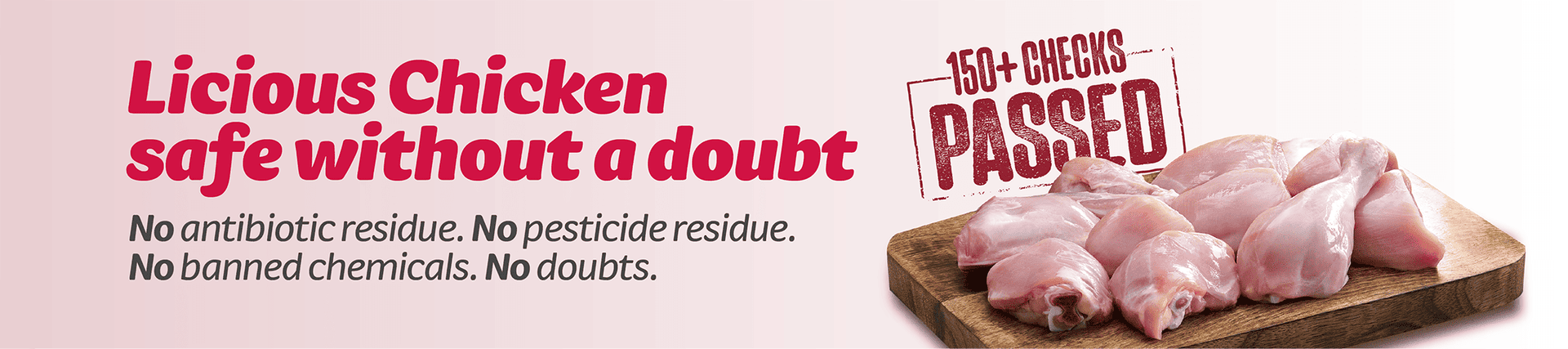
Quality Reports Banner

Licious Chicken External Lab Reports

A quick note on Licious Chicken safety

Before you go through our reports and the FAQ's section, here are a few things you should know about Licious Chicken:
- Our birds are raised on biosecure farms with controlled feed. We do not use hormones, and we test to ensure no antibiotic residue
- Chicken is expertly cut, thoroughly cleaned, and vacuum packed to retain freshness
- It is never frozen and stays within a strict 0–4°C cold chain, right up to your doorstep

How does Licious do 150+ checks?

When we say 150+ checks, we're referring to the overall system of quality controls for Licious chicken at every stage: the vendor, raw materials, processing, packing, hygiene, and ongoing verification through internal and external lab testing. It's not one giant test at the end. It's many small, non-negotiable gates that together ensure what reaches you is safe, consistent, and handled the way we would want food handled in our own homes.

We combine three layers of checks:

  • 40+ Daily process checksThese are pre-operational and in-process checks that verify hygiene readiness, equipment condition, sanitation effectiveness, and critical processing parameters.
  • 55+ Batch-level checksIn addition to daily controls, we run 55+ checks on every batch of chicken we pack in our facilities. These focus on product and packaging quality, process adherence, and batch release criteria.
  • 100+ Periodic compliance checksThese are deeper checks that continuously validate the system, including hygiene trends, finished-goods validation, and external lab analysis.

Together, these layers cross 150+ meaningful checkpoints before Licious chicken reaches you.

Q: Is Licious chicken safe to eat right now?

Yes. Licious chicken is completely safe to consume. Safety is non-negotiable for us, and every batch undergoes multiple checks before reaching you.

Q: Is Licious chicken impacted by the current chicken safety chatter online?

No. We understand why online content can feel alarming, but Licious chicken is not affected by the concern being circulated. We test regularly and will continue to share updates transparently.

Q: Was Nitrofuran found in Licious Chicken?

No, it was not found in the batches we tested. We screen for nitrofuran markers along with other antibiotic residues as part of our regular residue testing.

Q: Were any antibiotics found in Licious chicken?

No. We run checks for antibiotic residues as part of our chemical safety testing. Our reports have consistently shown no antibiotic residue in Licious chicken

Q: Were any pesticides found in Licious chicken?

No. We test for pesticide residues as part of our chemical safety framework. Our results have consistently shown no presence of pesticide residues in Licious chicken (as per the tests conducted).

Q: Do you test for banned substances like dyes or hormones?

Yes. We do not allow banned substances. Where relevant, we test for contaminants and banned chemicals as part of our safety framework.
Licious Chicken Lab Report | August 2025

Licious Chicken Lab Report | August 2025

Licious Chicken Lab Report | July 2025

Licious Chicken Lab Report | July 2025

Licious Chicken Lab Report | July 2025

Licious Chicken Lab Report | July 2025

Licious Chicken Lab Report | June 2025

Licious Chicken Lab Report | June 2025

Licious Chicken Lab Report | March 2025

Licious Chicken Lab Report | March 2025

Licious Chicken Lab Report | March 2025

Licious Chicken Lab Report | March 2025

Licious Chicken Lab Report | January 2025

Licious Chicken Lab Report | January 2025

Licious Chicken Lab Report | January 2025

Licious Chicken Lab Report | January 2025

Licious Chicken Lab Report | January 2025

Licious Chicken Lab Report | January 2025

Frequently Asked Questions (FAQ)

Frequently Asked Questions (FAQ's)

Q: What does Licious test for in chicken?

We test across a broad framework, including:

A. Microbiology (food safety)
Common pathogens and indicators that reflect hygiene and handling

B. Chemical safety
Antibiotic residues
Pesticide residues
Heavy metals (as applicable)
Other contaminants

C. Physico-chemical & freshness indicators
Temperature checks
pH/moisture and other quality indicators (as applicable)

D. Sensory (organoleptic) checks
Appearance, smell, and texture checks as part of quality control

Q: What's the difference between "quality" and "safety" in chicken?

Safety means it's fit to eat and meets microbiological and chemical safety checks.
Quality includes freshness, texture, taste, cut standards, and how well it was stored/handled.
At Licious, we focus on both.

Q: What makes your process safer than regular market chicken?

A big difference is control and consistency:
- Controlled sourcing and documented compliance
- Hygienic processing with defined SOPs
- 0-4 degrees temperature-controlled handling and storage
- Cold-chain distribution to maintain freshness and reduce risk

Q: Why does Licious use vacuum packaging?

Vacuum packaging helps maintain freshness and reduces exposure, which can slow microbial growth when combined with strict temperature control.

Q: How frequently do you test chicken?

We test regularly across batches and continue periodic third-party lab testing as part of our ongoing monitoring.

Q: How do I know the lab is credible?

We work with accredited, established labs that follow recognized food testing standards, validated methods, and strict quality controls. Our tests are conducted in FSSAI-notified, NABL-accredited labs.